By the end of 2025, Gartner predicts that 15% of all daily work tasks globally will be handled by autonomous AI agents, yet less than 5% of mid-market firms have moved beyond simple chatbots. The distinction is critical: while a chatbot waits for a prompt to generate text, an AI agent takes a goal, breaks it into steps, and uses external tools to complete it. At SEIO, we observe that businesses implementing these autonomous systems are reducing operational overhead by up to 40% in departments like customer success and outbound sales. The shift from generative AI to agentic AI represents the most significant change in corporate productivity since the introduction of cloud computing.
The Architecture of Autonomous AI Agents
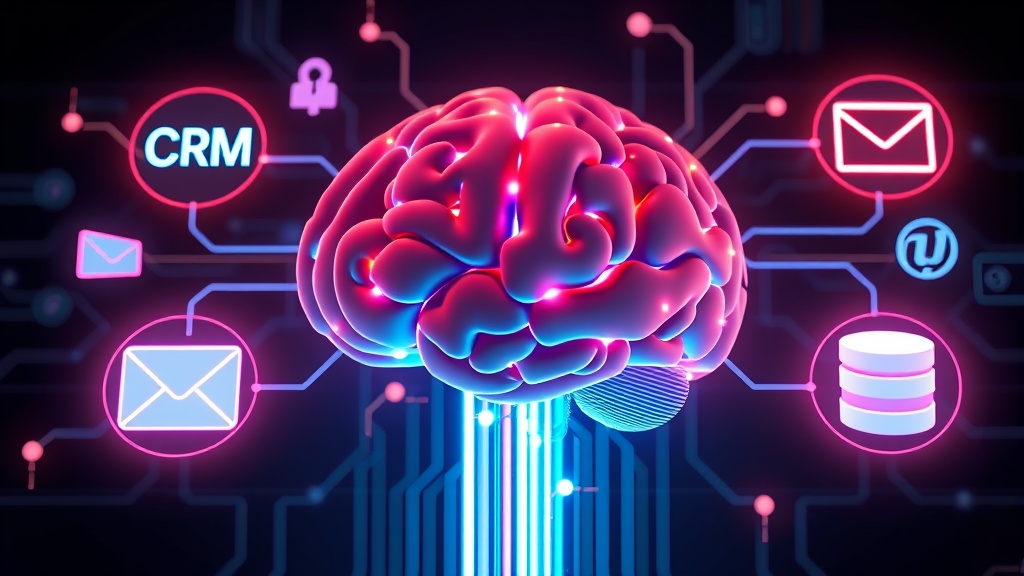
To understand why AI agents for business are different from the tools you used in 2023, you must look at their underlying architecture. An agent is not just a large language model (LLM); it is an LLM equipped with memory, planning capabilities, and tool access.
Reasoning and Planning
An agent uses techniques like Chain of Thought (CoT) to decompose a complex objective—such as “find 50 leads and draft personalized emails”—into discrete sub-tasks. It evaluates its own progress and adjusts its strategy if a specific tool or search query fails. This self-correction is what separates agents from standard automation scripts.
Long-term and Short-term Memory
Effective agents use vector databases to store past interactions and context. This allows an agent working within your organization to remember that a specific client prefers technical documentation over marketing summaries, ensuring that every subsequent action aligns with established preferences without human re-entry of data.
Tool Integration and Execution
Unlike a standard GPT instance, an agent can interact with your software stack. It can read a PDF, execute a SQL query on your database, or post an update to a Slack channel. This ability to act on the world makes it a functional digital employee rather than a simple text generator.
Operational Efficiency and Workflow Automation
Most companies struggle with fragmented data and manual hand-offs between departments. Deploying AI agents for business allows for the creation of “agentic workflows” where the AI manages the transition of a project from one stage to the next. This is a core component of Business Process Management Software in the modern era, where the software doesn’t just track work but actually performs it.
Automating Multi-Step Back-Office Tasks
Consider invoice processing. A standard automation might flag an invoice for review. An AI agent can ingest the invoice, cross-reference it with a purchase order in the ERP, verify that the goods were received via a logistics portal, and then draft the payment authorization for a human to click ‘approve’. SEIO specializes in identifying these high-friction points where agents provide the quickest return on investment.
Real-Time Resource Allocation
In logistics and service industries, agents can monitor incoming tickets or orders and dynamically assign them to the correct human team members based on current workload and expertise. This removes the middle-management bottleneck and ensures that high-priority tasks are never buried in an unmanaged inbox.
AI Agents in Sales and Marketing Strategy
Marketing is no longer about just broadcasting content; it is about precision and timing. Agents can analyze vast datasets to determine when a prospect is most likely to engage. This level of automation is a primary reason why the importance of digital transformation for today business cannot be overstated. If your competitors are using agents to personalize outreach at scale, manual processes will inevitably fall behind.
Autonomous Lead Prospecting
An agent can be programmed to monitor LinkedIn, industry news, and financial reports for specific trigger events—like a company receiving funding or a key executive change. Once a trigger is identified, the agent can research the individual, find their email, and draft a hyper-personalized message that references the specific event. This goes far beyond the capabilities of traditional mail-merge tools.
Enhancing Search Visibility
Agents are also becoming integral to how businesses maintain their online presence. By analyzing search trends and competitor movements in real-time, agents can suggest immediate content updates or technical fixes. This is particularly relevant when executing an AI SEO for small business strategy, where resource constraints often prevent manual daily monitoring.
Security, Governance, and Human-in-the-Loop
Granting an AI the ability to take actions carries inherent risks. A professional deployment of AI agents for business requires strict guardrails. According to a report by McKinsey, security and data privacy remain the top concerns for executives adopting autonomous systems.
Establishing Permission Tiers
An agent should never have unfettered access to a company’s entire database. At SEIO, we recommend a tiered permission structure where agents operate in a “sandbox” for specific tasks. For instance, a customer support agent might have read-access to a knowledge base but only write-access to a specific ticketing system, preventing accidental data corruption elsewhere.
The Role of Human Oversight
The goal is not to remove humans but to elevate them to the role of “Agent Manager.” Every high-stakes action—such as sending a final contract or authorizing a large refund—should require a human-in-the-loop (HITL) confirmation. This ensures that while the agent does the heavy lifting of preparation, the final accountability remains with a person.
Comparing AI Agents, Chatbots, and RPA
It is common to confuse these technologies, but their capabilities and use cases differ significantly. The following table highlights the functional gaps between them.
| Feature | AI Agents | Traditional Chatbots | RPA (Robotic Process Automation) |
|---|---|---|---|
| Decision Making | Autonomous & Reasoning-based | Scripted or Prompt-based | Rules-based (If-This-Then-That) |
| Environment | Adapts to dynamic changes | Static interactions | Breaks if UI changes slightly |
| Goal Orientation | Pursues complex, multi-step goals | Answers specific queries | Repeats repetitive tasks |
| Learning | Improves via feedback/memory | None (without retraining) | None |
Scaling Operations with SEIO Agent Frameworks
Implementation is the barrier between a demo and a deployed solution. Many businesses attempt to build agents using generic web-based tools only to find they cannot handle the edge cases of real-world business logic. SEIO provides the technical expertise to bridge this gap, ensuring that your agentic deployment is stable, secure, and measurable. We focus on creating agents that solve specific bottlenecks, whether that is in customer acquisition or internal data processing.
FAQ
What is the difference between an AI agent and an AI assistant?
An AI assistant, like a standard chatbot, requires a human to provide a prompt for every single action, whereas an AI agent is given a high-level goal and independently determines the steps and tools needed to achieve it without constant human intervention.
Are AI agents safe for handling sensitive company data?
Yes, provided they are deployed using private instances of LLMs and secure API connections. Using enterprise-grade frameworks allows you to keep data within your own cloud environment, ensuring that your proprietary information is never used to train public models.
How much technical expertise is required to deploy AI agents?
While low-code platforms exist, a robust business deployment usually requires knowledge of API integration, prompt engineering, and database management. Partnering with experts like SEIO ensures that the agents are properly integrated into your existing tech stack without creating technical debt.
Can AI agents replace human employees?
AI agents are designed to augment human work by handling repetitive, data-heavy, and multi-step administrative tasks. This allows human employees to focus on high-level strategy, creative problem-solving, and relationship management rather than manual data entry or basic research.
What are the most common use cases for AI agents in 2024?
The most frequent applications include automated lead generation, personalized customer support, complex scheduling, automated financial reporting, and real-time supply chain monitoring.
The Path Forward for Your Business
The transition to autonomous operations is not a matter of ‘if’ but ‘when’. Companies that adopt AI agents for business today gain a compounding advantage in data collection and operational efficiency that will be difficult for laggards to close in three years. By offloading the cognitive load of routine tasks to intelligent agents, your team can return to the work that actually drives growth and innovation. SEIO is ready to help you navigate this transition, from initial auditing of your workflows to the deployment of custom agentic systems. To begin your shift toward autonomous efficiency, contact the expert team at SEIO today and request a strategic consultation.