
An ontology is a map that tells a computer what things are and how they connect, so it can understand meaning instead of just matching words. If that still sounds abstract, don’t worry. By the end of this post you’ll understand it through something everyone knows: Sunday dinner at Granny’s.
Computers See Words, Not Meaning
Show a person the words Mary, Cara, Galway, granny and roast potatoes and they’ll start building a picture straight away. Mary is probably someone’s granny. Galway is a place. Roast potatoes are food, and someone at the table loves them.
A computer sees none of that. To a computer, those are just strings of letters. It doesn’t know Mary is a person, that Galway is a place, or that Mary is Cara’s granny.
That gap is why a website chatbot can give a confident wrong answer, or why a search box misses something you know is there. The words are present. The meaning isn’t. An ontology fills that gap.
So What Is an Ontology?
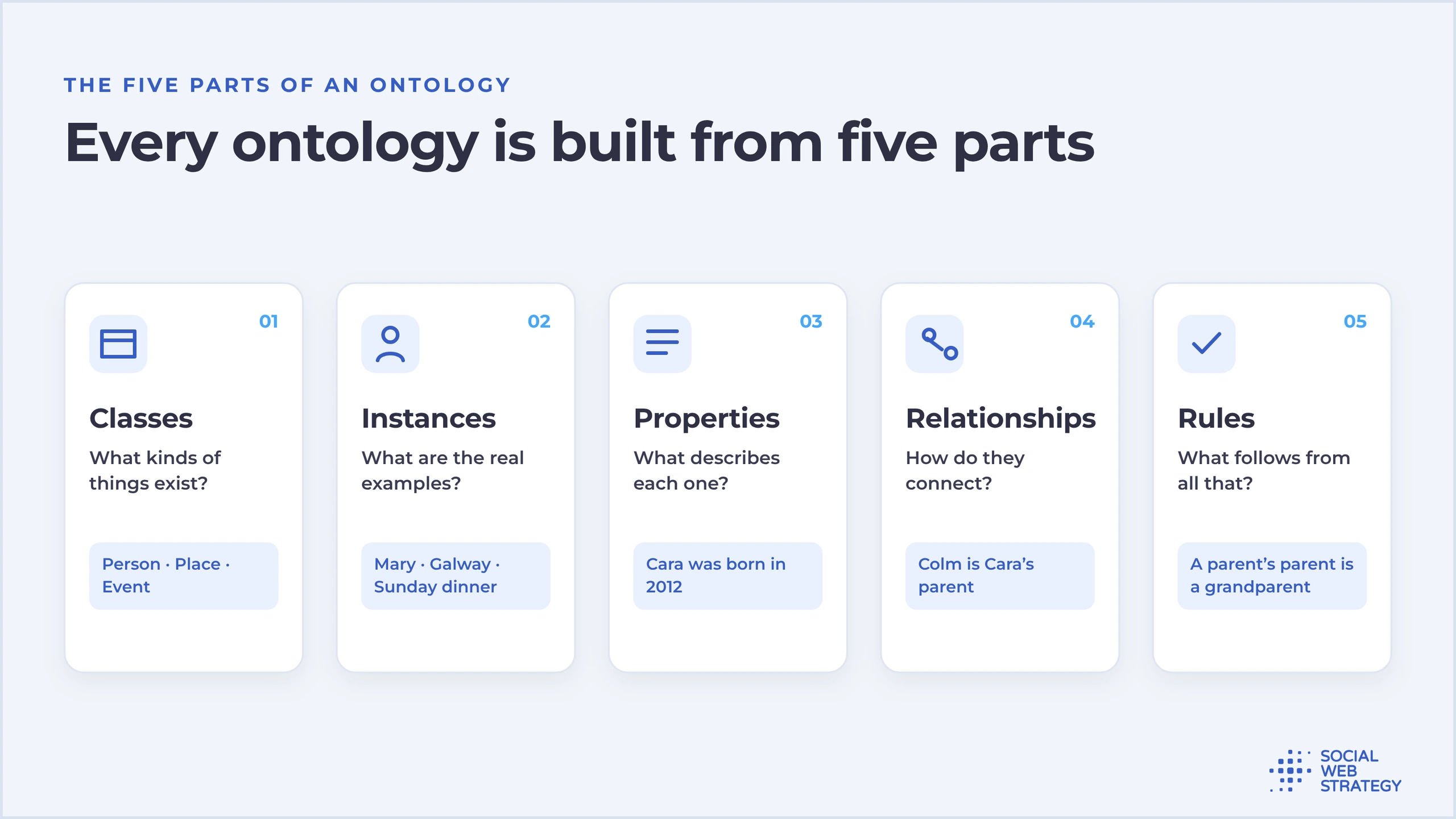
An ontology is a shared map of meaning. It writes down, in a way both people and machines can follow, five things about a subject:
| Part | What it answers | Sunday dinner example |
|---|---|---|
| Classes | What kinds of things exist? | Person, Place, Event |
| Instances | What are the real examples? | Mary, Galway, Sunday dinner |
| Properties | What describes each one? | Cara was born in 2012 |
| Relationships | How do they connect? | Colm is Cara’s parent |
| Rules | What follows from all that? | A parent’s parent is a grandparent |
That’s it. Every ontology, from a small business website to a hospital’s records system, is built from these five parts. Let’s sit down at the table and walk through each one.
Picture Sunday Dinner at Granny’s
Granny Mary is hosting. Her son Colm and her daughter Caitríona are there. Colm’s twins, Seán and Cara, are there, and so is Caitríona’s son Donnacha. Everyone, and everything they talk about, can be described with those five parts.
1. Classes: The Kinds of Things That Exist
Before you name anyone, you decide what kinds of things are in your world. At this dinner there are three:
- Person: the people at the table
- Place: Granny’s house, Galway
- Event: the Sunday dinner itself
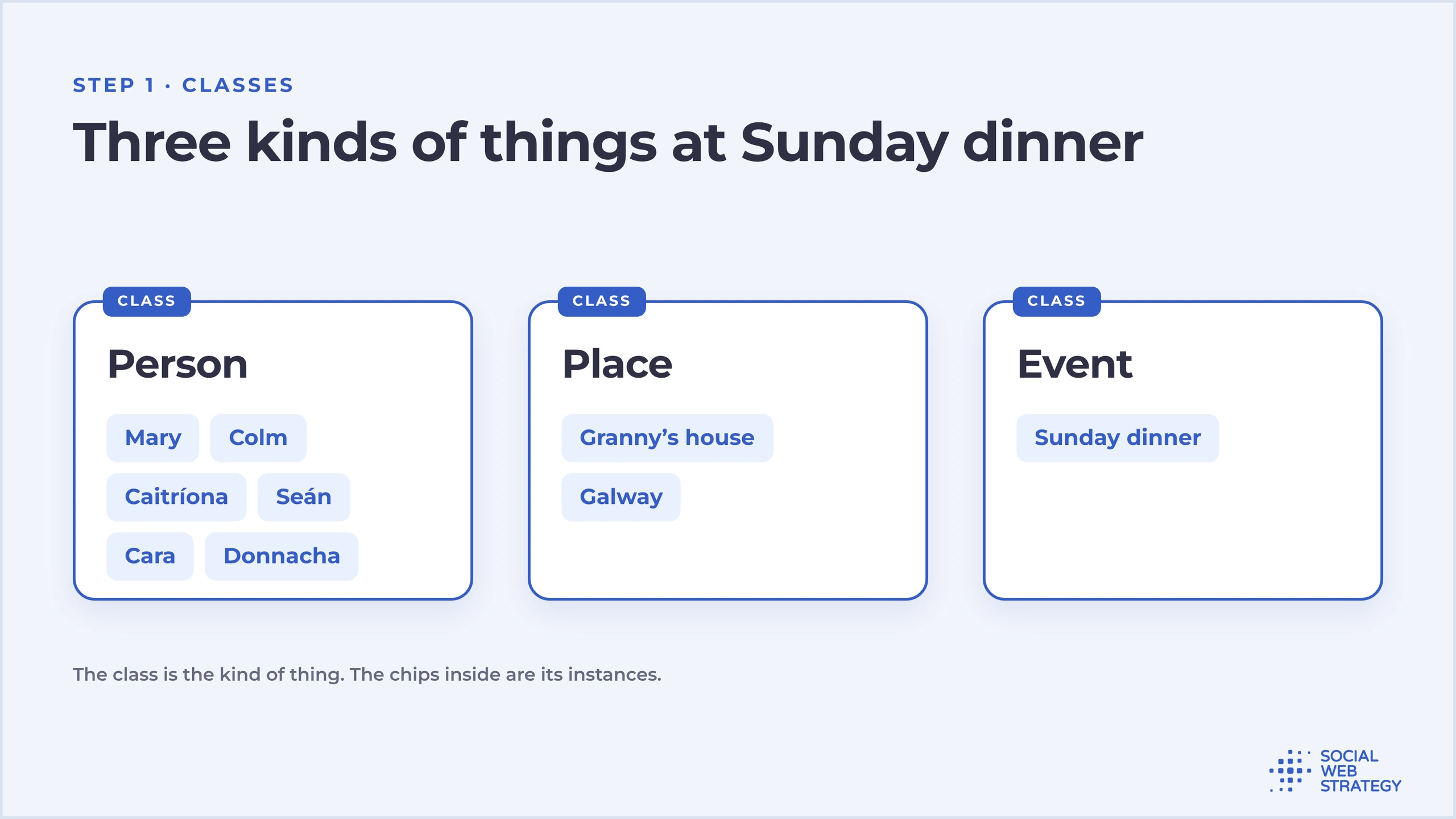
A class is like a labelled box. It doesn’t hold anyone yet. It just says “things of this kind exist here”.
2. Instances: The Real Things in Each Class
Now you fill the boxes. Mary, Colm, Caitríona, Seán, Cara and Donnacha are instances of Person. Granny’s house and Galway are instances of Place. This week’s Sunday dinner is an instance of Event.
The easy way to remember it: a class is the kind of thing, an instance is the actual one.
3. Properties: The Facts That Describe Each Thing
Each instance can carry facts about itself. Take Cara: she was born in 2012, lives in Galway, loves roast potatoes and plays soccer.
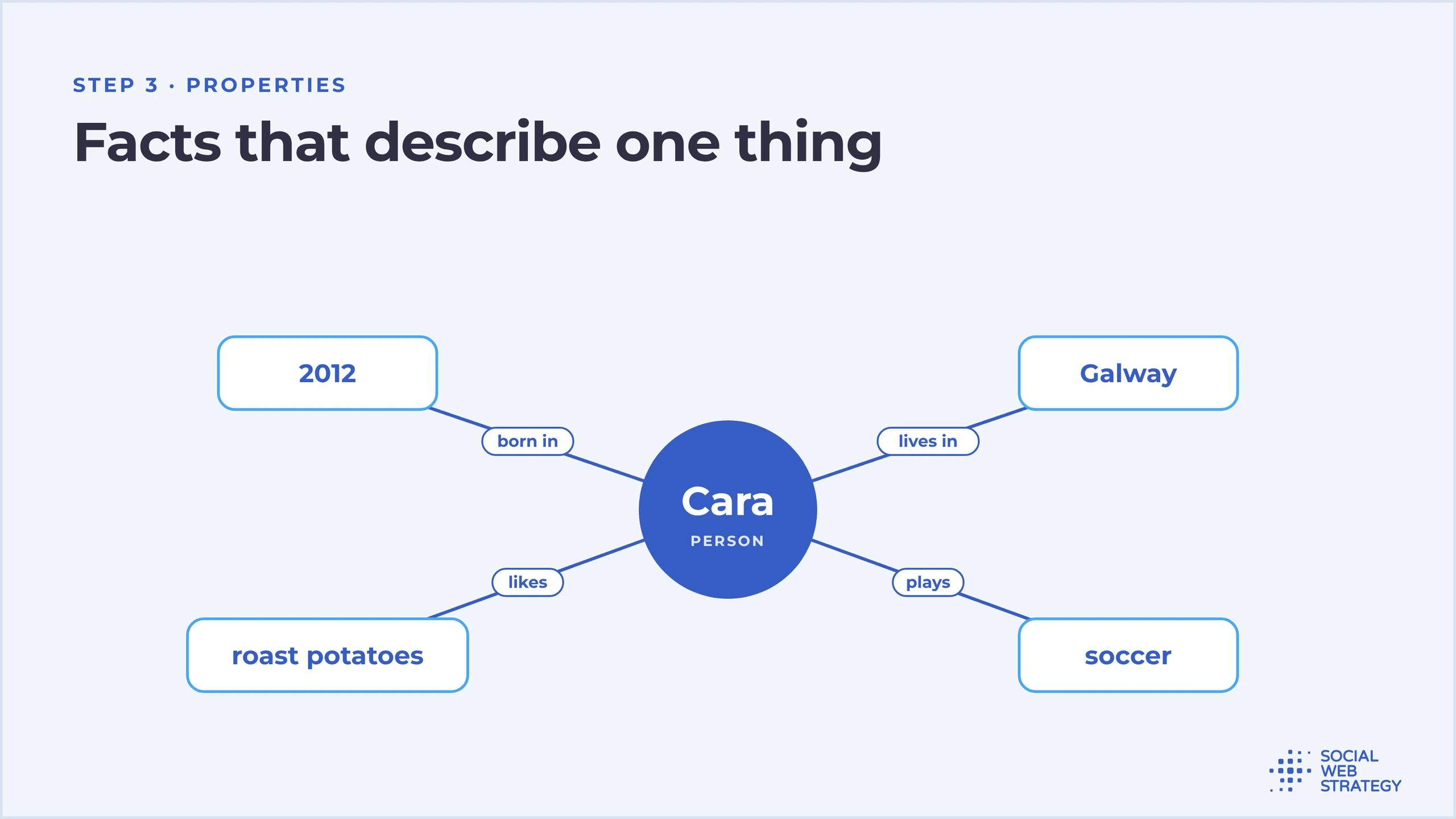
Properties are what you’d write on someone’s name card at the table. They describe one thing on its own.
4. Relationships: How Things Connect
This is where an ontology starts to feel different from a list. Relationships link one instance to another:
- Mary is a parent of Colm and Caitríona
- Colm is a parent of Seán and Cara
- Caitríona is a parent of Donnacha
- Colm and Caitríona are siblings
- Seán and Cara are twins
Each relationship is a simple, readable sentence: thing, connection, thing. Colm, parent of, Cara. Computers are very good at storing millions of these little sentences.
5. Rules: Working Out New Facts
Here’s the clever bit. You can give the ontology rules, such as:
- A parent of a parent is a grandparent.
- The children of siblings are first cousins.
Nobody ever typed in “Mary is Cara’s granny” or “Donnacha and Cara are cousins”. But with those two rules, the computer works both facts out by itself. Mary is Colm’s parent, Colm is Cara’s parent, so Mary must be Cara’s grandparent. The same rule shows she’s granny to Seán and Donnacha too.
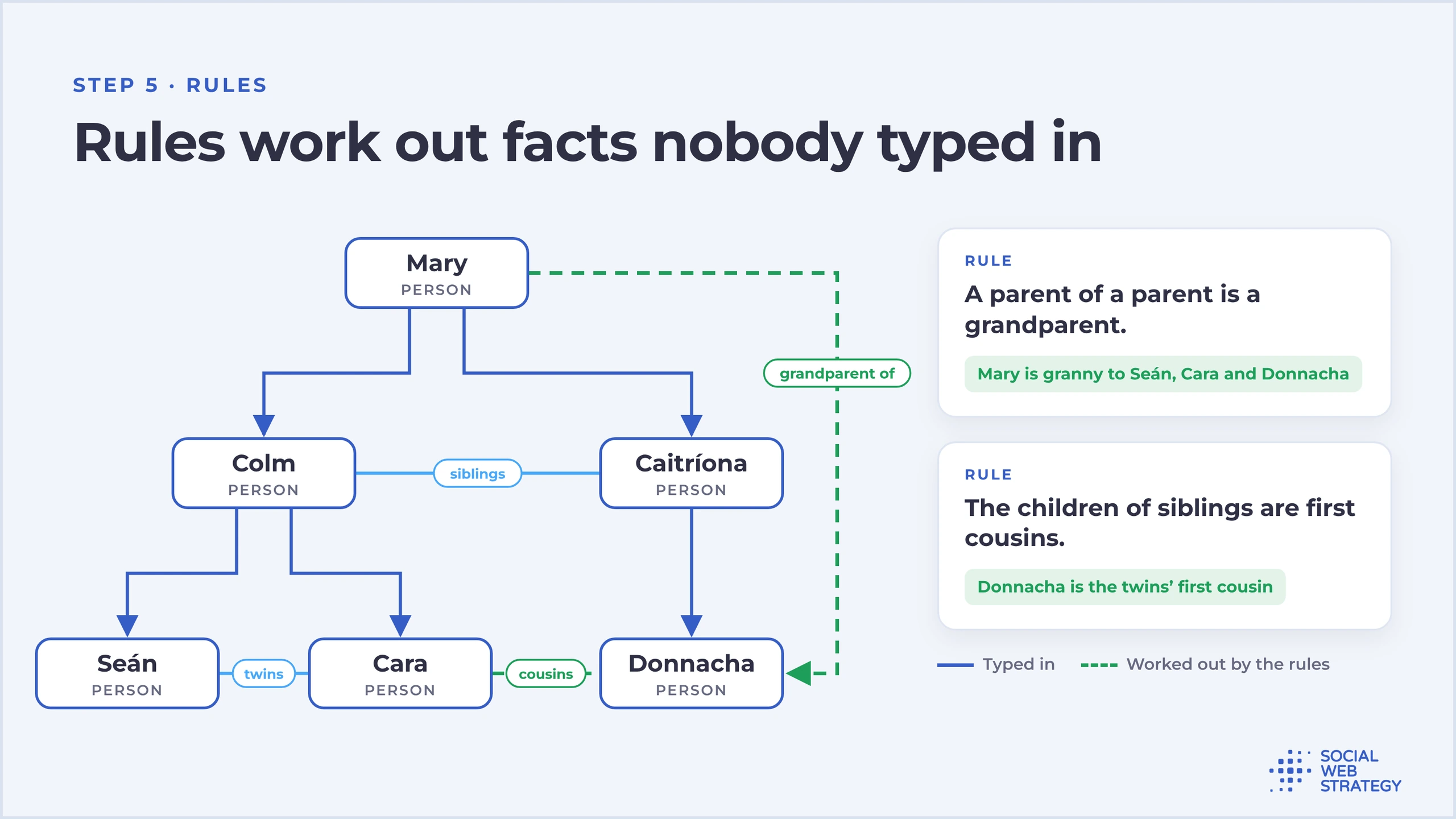
That’s the real power of an ontology. It doesn’t just store what you told it. It can reason about it, the same way anyone at the table would.
Ontology vs Taxonomy: What’s the Difference?
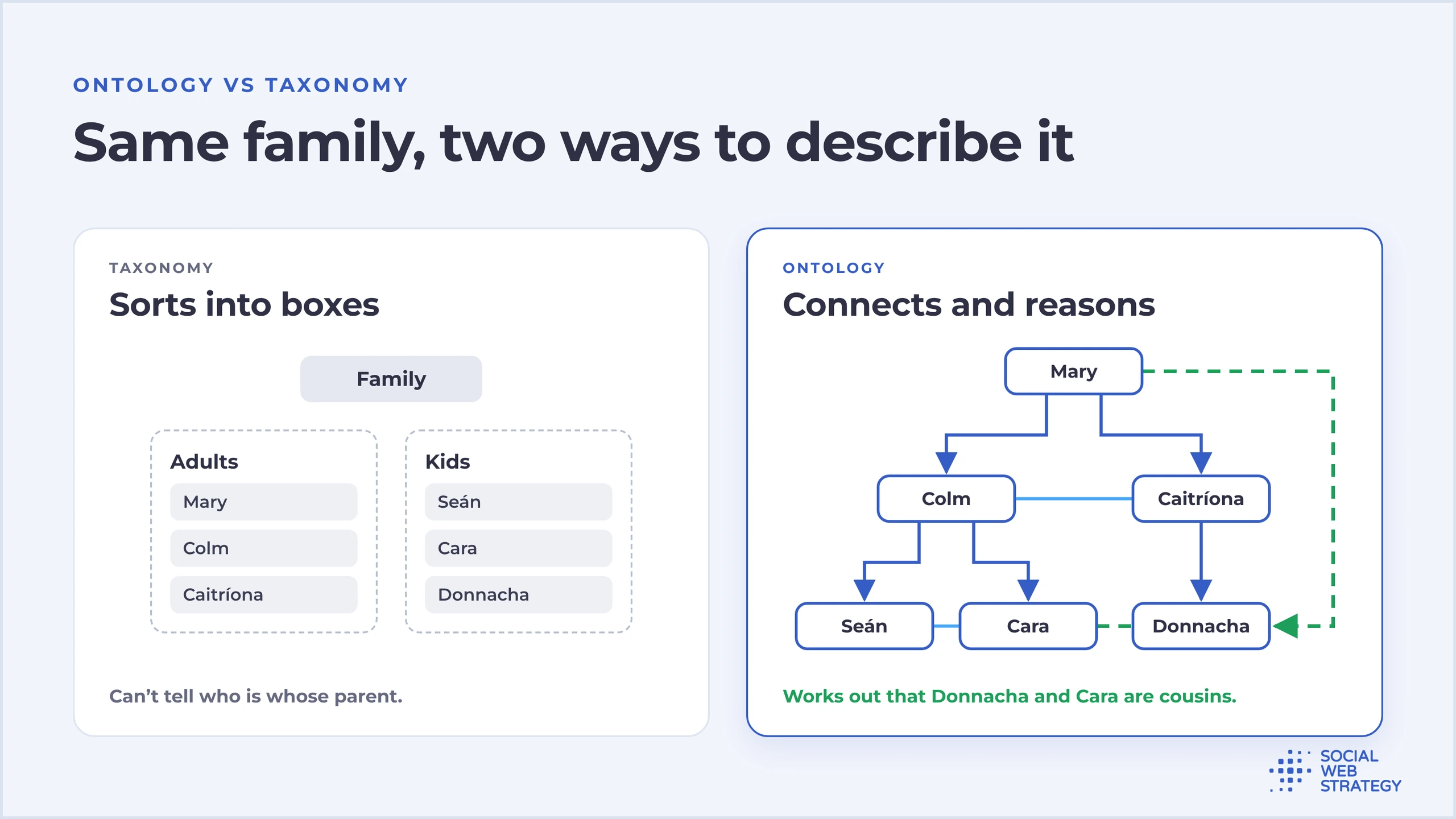
A taxonomy is a category tree. It sorts things into tidy boxes. An ontology connects those things and reasons about them.
A taxonomy of the family might put Mary, Colm and Caitríona under Adults, and Seán, Cara and Donnacha under Kids. That’s useful for filing, but it can’t tell you who is whose parent, and it can never work out that Donnacha and Cara are cousins.
| Taxonomy | Ontology | |
|---|---|---|
| What it does | Sorts things into groups | Describes things and how they connect |
| Shape | A tree: each item sits under one parent | A web: anything can link to anything |
| Can it work out new facts? | No | Yes, using rules |
| Everyday example | The aisles in a supermarket | The family at Sunday dinner |
Most good ontologies contain a taxonomy, because the classes are usually arranged as one. The relationships and rules are what they add on top.
Now Swap the Family for Your Business
Replace Granny’s dinner table with your business and the same five parts apply:
- Classes: products, services, customers, locations, staff
- Instances: your actual products and your actual branches
- Properties: prices, sizes, opening hours, delivery areas
- Relationships: this product is available at that branch; this service includes that add-on
- Rules: if a branch is closed on Sundays, nothing can be collected there on a Sunday
When that knowledge is written down as an ontology, the systems that read it get much smarter:
- AI chat and voice assistants can give the right answer to “Can I collect this in Galway on Sunday?” instead of guessing from loosely matching text. This is how we build an AI assistant for your website.
- Search engines and AI search can understand what your business offers, not just which keywords appear on the page. Structured data on your website, often called schema markup, is a small, practical step in this direction and part of good search engine optimisation.
- Your own team gets one agreed definition of things, so “customer” or “order” means the same thing in every system and spreadsheet.
You don’t need to build a giant ontology to benefit. Even a clear, written-down model of your products, services and how they connect makes an AI assistant far more reliable. For larger organisations, the same idea sits behind our enterprise AI assistants.
The One-Minute Recap
- Computers see words, not meaning.
- An ontology is a shared map of meaning built from classes, instances, properties, relationships and rules.
- Classes are kinds of things; instances are the real ones.
- Relationships connect things; rules let the computer work out facts nobody typed in.
- Applied to your business, it helps AI assistants and search give the right answer, not just a matching keyword.
Frequently Asked Questions (FAQs)
Is an Ontology the Same as a Database?
Not quite. A database stores data. An ontology describes what that data means and how it fits together. The two often work side by side.
What Is a Knowledge Graph?
A knowledge graph is an ontology filled in with real data: all the instances and the links between them. The ontology is the plan; the knowledge graph is the house built from it.
Do Small Businesses Really Need an Ontology?
You probably don’t need a formal ontology on day one. But if you’re adding an AI assistant to your website, the quality of its answers depends on how clearly your information is organised and connected.
Where Does the Word Ontology Come From?
It’s borrowed from philosophy, where ontology means the study of what exists. In computing, it means writing down what exists in a particular subject so machines can use it.
Want AI That Actually Understands Your Business?
At Social Web Strategy we build AI chat and voice assistants that answer from your organisation’s own information, and websites that search engines and AI tools can properly understand. Our founder, Ina O’Murchu, researched ontologies and knowledge graphs at DERI, NUI Galway, so this is the thinking behind every assistant we build.
If you’d like your information organised so your assistant gets the answer right, get in touch or request a quote.